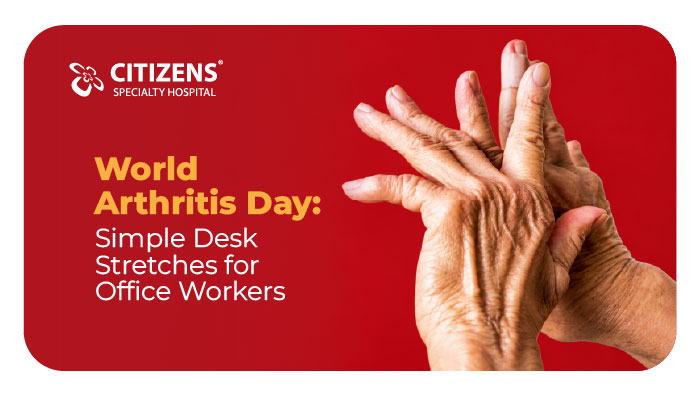
World Arthritis Day: Simple Desk Stretches for Office Workers
Every year on 12 October, World Arthritis Day reminds us that joint health is not just a concern for
older adults. Arthritis and joint stiffness increasingly affect people in their 30s and 40s, and one of
the biggest contributors is something millions of us do every working day: sitting still for hours at a
desk.
When joints stay in one position for too long, the fluid that lubricates them circulates less,
surrounding muscles tighten, and small aches slowly turn into chronic discomfort. For people who
already have arthritis, long stretches of inactivity can make morning stiffness and afternoon pain
noticeably worse.
The good news is that you don't need a gym, special equipment or even a change of clothes to
protect your joints. A few minutes of gentle movement, done regularly at your desk, can make a
real difference.
Why Desk Work Is Hard on Your Joints
Our joints are designed for movement. Cartilage, the smooth tissue that cushions the ends of
bones, has very limited blood supply and depends on movement to receive nutrients from joint
fluid. When you sit for long periods, several things happen:
- Joint fluid circulates less , leaving joints feeling stiff when you finally stand up.
- Muscles shorten and tighten , especially the hip flexors, hamstrings and chest muscles.
- Posture drifts forward , putting extra load on the neck, upper back and lower spine.
- Repetitive hand movements , such as typing and using a mouse, strain the small joints of
the wrists and fingers.
- Reduced activity can contribute to weight gain, which increases pressure on weight-
bearing joints like the knees and hips.
For people with osteoarthritis, rheumatoid arthritis or other inflammatory joint conditions, these
effects can amplify existing symptoms. For those without arthritis, they can set the stage for joint
problems later in life.
Before You Begin: A Few Safety Tips
Stretching should feel comfortable, never painful. Keep these guidelines in mind:
- Move slowly and smoothly. Avoid bouncing or jerking movements.
- Breathe normally throughout. Holding your breath increases tension.
- Stretch to the point of a gentle pull, not pain.
- Hold each stretch for 15 to 30 seconds unless otherwise noted.
- If a joint is red, hot or swollen, rest it and speak to a doctor before stretching.
- If you have had recent surgery or a joint replacement, ask your doctor or physiotherapist
which movements are safe for you.
Neck and Shoulder Stretches
The neck and shoulders carry much of the tension from screen work, especially when the monitor
is too low or you lean towards the screen.
Neck Side Tilt
- Sit tall with your shoulders relaxed.
- Slowly tilt your right ear towards your right shoulder until you feel a stretch on the left side
of your neck.
- Hold for 15 to 20 seconds, then repeat on the other side.
- Keep your shoulders down; don't lift them towards your ears.
Chin Tucks
This simple movement counteracts the "forward head" posture common among desk workers.
- Sit upright and look straight ahead.
- Gently draw your chin straight back, as if making a double chin.
- Hold for 5 seconds and release. Repeat 8 to 10 times.
Shoulder Rolls
- Lift your shoulders towards your ears, roll them backwards and then down.
- Do 10 slow rolls backwards, then 10 forwards.
Upper Back Squeeze
- Sit tall and gently squeeze your shoulder blades together, as if holding a pencil between
them.
- Hold for 5 seconds and relax. Repeat 10 times.
Wrist, Hand and Finger Stretches
Typing and mouse work can cause stiffness in the hands, which is especially uncomfortable for
people with arthritis in the finger joints.
Wrist Flexor Stretch
- Extend one arm in front of you, palm facing up.
- With your other hand, gently bend the wrist downwards so your fingers point towards the
floor.
- Hold for 15 to 20 seconds and switch hands.
Wrist Extensor Stretch
- Extend one arm with the palm facing down.
- Gently press the back of the hand so the fingers point downwards.
- Hold for 15 to 20 seconds and switch.
Finger Spread and Fist
- Make a gentle fist, then slowly open your hand and spread your fingers as wide as
comfortable.
- Repeat 10 times on each hand.
- If a full fist is painful, curl the fingers only as far as feels comfortable.
Thumb Touches
- Touch your thumb to the tip of each finger, one at a time, making an "O" shape.
- Repeat the sequence 3 to 5 times on each hand.
Back and Spine Stretches
Seated Spinal Twist
- Sit tall with both feet flat on the floor.
- Place your right hand on the outside of your left knee and your left hand on the back of the
chair.
- Gently rotate your upper body to the left. Hold for 15 to 20 seconds.
- Return to centre and repeat on the other side.
- Rotate from the middle of your back rather than forcing the neck.
Seated Cat-Cow
- Sit near the edge of your chair with hands on your knees.
- As you breathe in, arch your back gently and lift your chest.
- As you breathe out, round your back and let your chin drop slightly.
- Repeat 8 to 10 times.
Overhead Reach
- Interlace your fingers and reach your arms overhead, palms facing the ceiling.
- Lengthen through your spine and hold for 10 to 15 seconds.
- For a side stretch, lean gently to the right and then the left.
Hip, Knee and Ankle Stretches
Sitting keeps the hips bent for hours, which tightens the muscles around them and can contribute
to lower back and knee discomfort.
Seated Figure-Four Stretch
- Sit tall and cross your right ankle over your left knee.
- Keeping your back straight, lean forward slightly until you feel a stretch in the right hip and
buttock.
- Hold for 20 to 30 seconds and switch sides.
- Skip this stretch if you have had a hip replacement, unless your surgeon has cleared it.
Seated Knee Extensions
- Sit upright and slowly straighten one knee until your leg is parallel to the floor.
- Hold for 3 to 5 seconds, then lower slowly.
- Repeat 10 times on each leg. This strengthens the thigh muscles that support the knee.
Ankle Circles
- Lift one foot slightly off the floor and draw slow circles with your toes.
- Do 10 circles in each direction, then switch feet.
Standing Hip Flexor Stretch
- Stand behind your chair and hold the backrest for balance.
- Step one foot back, keeping the heel lifted, and gently tuck your hips forward.
- Hold for 20 seconds and switch legs.
A Simple 5-Minute Desk Routine
If remembering many stretches feels overwhelming, try this quick routine two or three times a day:
- Shoulder rolls: 30 seconds
- Neck side tilts: 40 seconds (both sides)
- Chin tucks: 30 seconds
- Wrist flexor and extensor stretches: 1 minute
- Finger spread and fist: 30 seconds
- Seated spinal twist: 40 seconds (both sides)
- Seated knee extensions: 1 minute
Set a reminder on your phone or computer, or link the routine to regular events such as after a
meeting or before lunch.
Everyday Habits That Protect Your Joints at Work
Stretching works best when combined with healthy workplace habits:
- Follow the 30-minute rule. Stand up, walk or change position at least every 30 minutes.
- Set up your workstation properly. Keep the top of your monitor at or slightly below eye
level, your elbows at about 90 degrees and your feet flat on the floor.
- Use supportive seating. A chair with lumbar support helps maintain the natural curve of
your lower back.
- Take walking calls. Stand or walk during phone calls when possible.
- Stay hydrated. Regular water breaks keep you hydrated and naturally get you moving.
- Keep warm. Air-conditioned offices can increase stiffness; a light layer over the shoulders
or knees can help.
- Maintain a healthy weight. Every extra kilogram adds load on the knees during walking and
climbing stairs.
When Joint Pain Needs Medical Attention
Stretches can ease everyday stiffness, but they are not a substitute for medical care. See a doctor if
you notice:
- Joint pain that lasts more than a few weeks
- Morning stiffness lasting longer than 30 minutes
- Swelling, redness or warmth around a joint
- Pain that wakes you up at night
- Reduced range of motion or difficulty gripping objects
- Joint pain along with fever, fatigue or unexplained weight loss
- Pain affecting the same joints on both sides of the body, which can be a sign of
inflammatory arthritis
Early diagnosis matters, particularly for rheumatoid arthritis, where timely treatment can help
prevent permanent joint damage. Your doctor may recommend blood tests such as rheumatoid
factor, anti-CCP antibodies, ESR or CRP, along with X-rays or other imaging to understand what is
causing your symptoms.
Concusion
This World Arthritis Day, give your joints the movement they need. A few minutes of gentle
stretching several times a day can reduce stiffness, improve flexibility and help you feel more
comfortable through long working hours. Combine these stretches with a good workstation setup
and regular breaks, and your joints will thank you in the years ahead.
If you already live with persistent joint pain or stiffness, don't simply stretch through it. A proper
evaluation can identify the cause and guide the right treatment. Book your test with Citizens
Specialty Hospital and take the first step towards healthier, more comfortable joints.